Last updated: June 11, 2026
Business Canvas
Create and iterate on your business model using structured canvas frameworks.
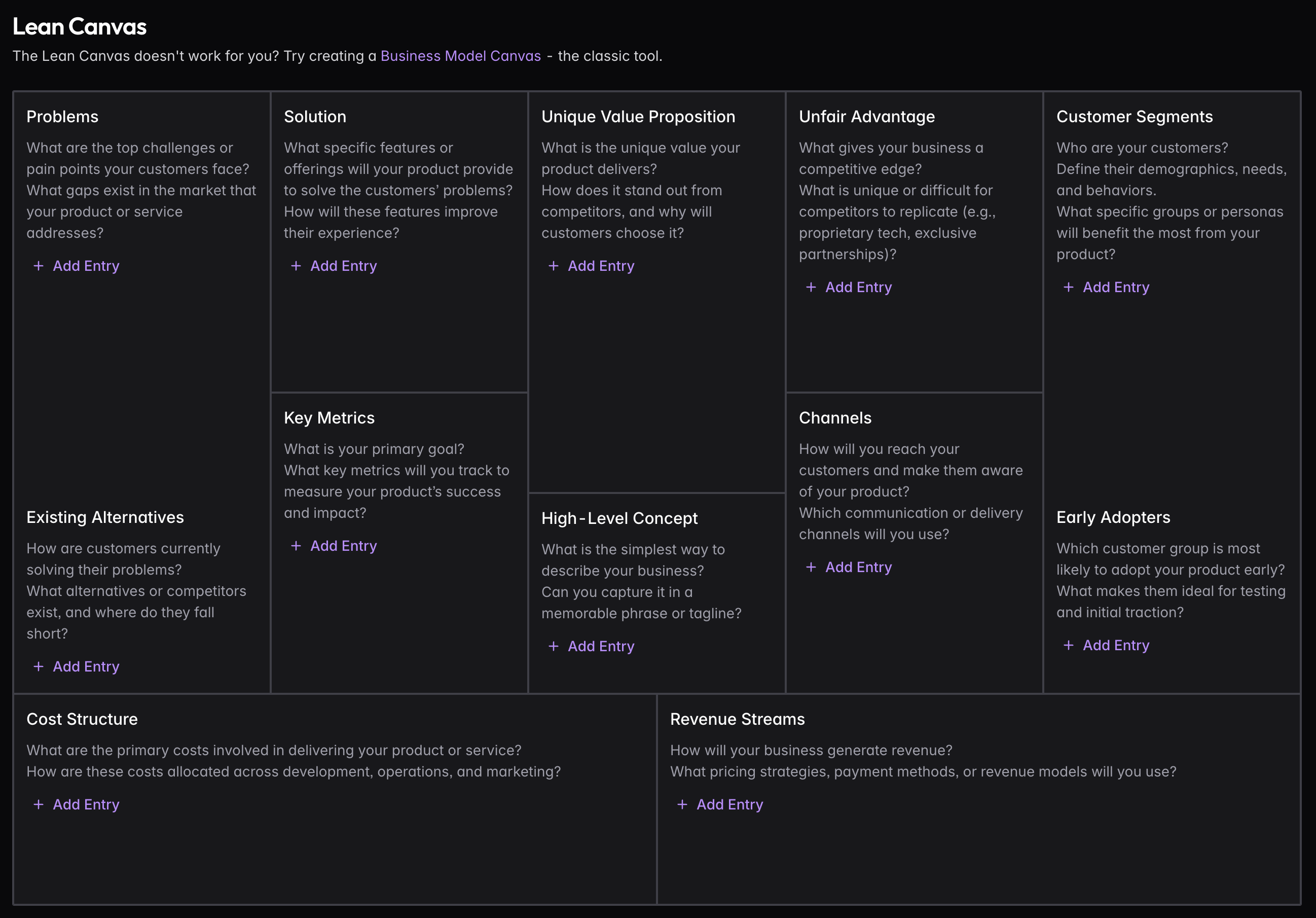
Canvas Types
Lean Canvas is focused on problem-solution fit — best for early-stage startups validating ideas. It emphasizes the problem, solution, unique value proposition, and key metrics.
Business Model Canvas is more comprehensive, adding partnerships, resources, and cost structure. Use this when you’re past validation and building out operations.
Switch between canvas types using the tabs at the top of the page.
Working with Entries
Click the + button in any section to add an entry. Click any entry to edit it — changes save automatically. Drag entries to reorder or move between sections.
Lean Canvas FAQ
What is the Lean Canvas?
The Lean Canvas is a version of the Business Model Canvas optimized for startups. It’s a one-page business plan template that helps you document your business model assumptions, ensure you’re addressing real problems, and focus on the metrics that matter most for your startup’s success.
What are the benefits of Lean Canvas?
- Streamlined Approach: Condenses complex plans into a single page for clarity.
- Swift Adaptation: Easy to iterate and refine as new insights emerge.
- Hypothesis Testing: Encourages validating assumptions with feedback.
- Optimal Resource Use: Focuses efforts on critical business elements.
- Risk Mitigation: Systematically addresses risks early in development.
What are the elements of Lean Canvas?
The nine key sections of Lean Canvas:
- Problem: Identify customer pain points and gaps in existing solutions.
- Customer Segments: Define your target audience, focusing on early adopters.
- Unique Value Proposition (UVP): Articulate what sets your product apart.
- Solution: Highlight key features addressing the identified problem.
- Channels: Plan how to promote and deliver your product.
- Revenue Streams: List ways your product will generate revenue.
- Cost Structure: Identify fixed and variable costs.
- Key Metrics: Define KPIs to measure progress and success.
- Unfair Advantage: Highlight unique factors that make your product hard to replicate.
What’s the difference between Lean Canvas and Business Model Canvas?
Lean Canvas adapts the Business Model Canvas to the startup environment, replacing Key Partners, Key Activities, Key Resources, and Customer Relationships with:
- Problem: Focuses on finding product/market fit by identifying market gaps.
- Solution: Encourages considering multiple ideas within limited space.
- Key Metrics: Defines success indicators from the ground up.
- Unfair Advantage: Highlights unique, hard-to-replicate factors.
What are the common pitfalls when using Lean Canvas?
- Unclear Customer Segments: Leads to confusion and irrelevant strategies.
- Skipping Problem Validation: Assumptions about customer problems must be tested.
- Neglecting Solution Validation: MVP testing ensures solutions address real needs.
- Ignoring Feedback: Sticking to assumptions hinders adaptability and product-market fit.
- Weak Value Proposition: Must be specific, compelling, and customer-centric.
Business Model Canvas FAQ
What is the purpose of Business Model Canvas?
The purpose of BMC is to outline, analyze, and design a business model, enabling strategic decision-making and providing a concise one-page business plan summary of nine key components. It helps organizations visualize how different parts of their business interrelate.
Tips for Creating an Effective Business Model Canvas
- Keep it simple: Focus on clarity and conciseness.
- Continuously update: Regularly adapt your BMC to market changes.
- Collaborate: Involve your team to gather diverse insights.
- Test and validate: Experiment, measure results, and refine your model.
What should be included in Business Model Canvas?
The nine key sections of a BMC:
- Customer Segments: Target groups for your product/service.
- Key Partnerships: Partners and suppliers essential to your business.
- Key Activities: Critical tasks to make the business model successful.
- Revenue Streams: How the business generates revenue.
- Value Propositions: Why customers choose your product.
- Channels: Methods to deliver, promote, and sell the product.
- Key Resources: Assets required to deliver value propositions.
- Customer Relationships: Channels for engaging with customers.
- Cost Structure: Primary expenses tied to the business model.